Choosing the technology behind a business website can feel more complicated than it needs to be.
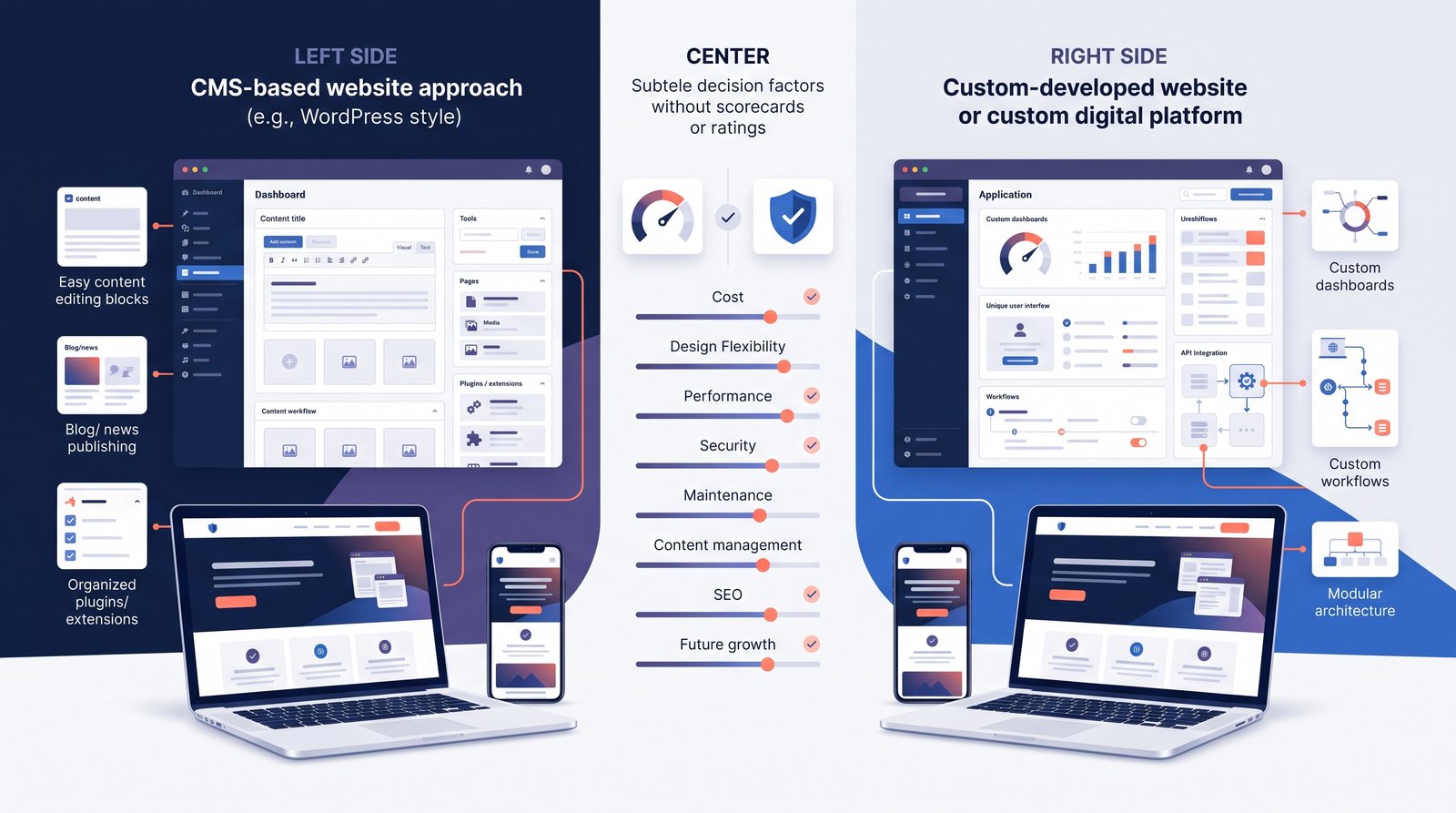
Many businesses eventually compare two common options: WordPress and a custom-built website.
Both can be good choices. The important question is not which one is universally better, but which approach fits your business, budget, content needs, functionality, and plans for the future.
A restaurant, local service company, online publisher, and software business may all need websites, but their requirements can be completely different.
What Is WordPress?
WordPress is a content management system that allows businesses to create and manage website content through an administrative interface.
- It is widely used for:
- Company websites
- Blogs
- News websites
- E-commerce stores
- Portfolio websites
- Membership websites
- Content-heavy sites
One of the main advantages is that businesses can update many parts of the website without editing the underlying code directly.
Themes and plugins can also provide functionality without requiring every feature to be built from scratch.
What Is a Custom Website?
A custom website is developed specifically around the requirements of the business.
Instead of starting with a pre-built theme and extending it, developers can control the:
- User interface
- Page structure
- Functionality
- Code architecture
- Integrations
- Data flow
- Performance strategy
Custom development is often considered when a business needs something beyond a conventional marketing website.
- WordPress vs Custom: The Main Difference
- A simple way to think about it is:
WordPress: Start with an established platform and customize it.
Custom development: Build the website around the specific requirements.
Neither approach is automatically superior.
The better choice depends on the project.
- When WordPress May Be a Good Choice
WordPress can be practical when a business needs a website that staff can update regularly.
- For example, it can work well for:
- Company websites
- Blogs
- News portals
- Service websites
- Content publishing
- E-commerce
It can also be useful when the team wants access to a large ecosystem of themes, plugins, integrations, and developers familiar with the platform.
For content-driven businesses, being able to publish and edit pages without technical assistance can be particularly useful.
- When Custom Development May Be Better
Custom development becomes more attractive when the website needs functionality that does not fit comfortably into a standard setup.
- Examples include:
- Custom customer portals
- Complex dashboards
- Specialized booking systems
- Internal business tools
- Advanced API integrations
- Industry-specific workflows
- Unique user experiences
A custom system can be structured around how the business actually operates rather than adapting the business process to a platform.
Cost: Which One Is Cheaper?
This depends on the project.
A basic WordPress website can be relatively efficient to launch because many common functions already exist.
However, costs can increase when a WordPress project requires:
- Multiple premium plugins
- Custom development
- Theme modifications
- Advanced integrations
- Ongoing troubleshooting
Custom development can require more investment at the beginning because the system is built specifically for the project.
But comparing only the initial price can be misleading.
- You should also consider:
- Maintenance
- Hosting
- Updates
- Future changes
- Plugin or service subscriptions
- Support
- Design Flexibility
Both approaches can produce professional websites.
WordPress can be highly customized through themes, builders, custom code, and design systems.
However, custom development provides more direct control over the final structure.
This can matter when a business wants a completely unique interface instead of adapting an existing theme or component system.
The important thing is not whether a site is technically custom. It is whether the design supports the user's needs.
- Performance Considerations
A fast website depends on more than the platform.
- Performance can be affected by:
- Image sizes
- JavaScript
- Third-party scripts
- Fonts
- Hosting
- Code quality
- Plugins
- Database queries
- Caching
A well-optimized WordPress website can perform well.
Likewise, poorly developed custom code can still result in a slow website.
Performance should therefore be treated as a development requirement rather than simply a platform feature.
- Security and Maintenance
This is an area where the two approaches can differ significantly.
- WordPress websites typically involve:
- Core updates
- Plugin updates
- Theme updates
- Security monitoring
- Backups
Every additional plugin or integration can introduce another component that needs to be maintained.
A custom website may have fewer dependencies, particularly when it is a simple static site. That can reduce some maintenance requirements.
However, custom code still needs to be secured, monitored, updated when necessary, and hosted properly.
No platform is automatically secure simply because it is WordPress or custom-built.
- Content Management
This is one of WordPress's strongest advantages.
A business that publishes articles, news, products, or other content frequently may appreciate having a dedicated content management interface.
For example, a marketing team can publish a new blog post without depending on a developer for every update.
A custom website can also include content management functionality, but that system needs to be built or integrated separately.
- SEO Considerations
Neither WordPress nor custom development automatically guarantees better SEO.
- Search performance depends on factors such as:
- Content quality
- Search intent
- Page structure
- Technical SEO
- Mobile usability
- Page speed
- Internal linking
- Metadata
- Backlinks
- Overall website quality
WordPress provides many tools that can make SEO management easier, while custom websites can provide very precise technical control.
The implementation matters more than the label.
What About E-commerce?
WordPress can be a practical choice for many online stores because established e-commerce tools can provide:
- Product management
- Shopping cart
- Checkout
- Payments
- Order handling
- Inventory
A custom e-commerce system may be appropriate when the business has highly specialized requirements that standard solutions do not handle well.
Again, the choice should be based on business needs rather than the assumption that custom is always more advanced.
What About Blogs and News Websites?
For content-heavy websites, WordPress can be especially practical because publishing and managing large amounts of content is a core part of its ecosystem.
A custom system can also handle publishing, but the content-management experience needs to be designed carefully.
A news organization publishing many articles each week may prioritize editorial workflow, author management, categories, media management, and publishing speed.
Those requirements should influence the technology decision.
What About Small Business Websites?
- For a small business that mainly needs:
- Home
- About
- Services
- Portfolio
- Contact
- Blog
either approach can work.
The better choice may depend on how frequently the business expects to edit content and whether future functionality is likely to become more complex.
A simple static website may be perfectly suitable when content changes are limited.
A CMS can be more convenient when the business expects regular publishing.
- Don't Choose Based on Technology Hype
- It is easy to hear statements like:
- “Custom websites are always better.”
- or:
- “WordPress is always cheaper.”
Neither statement is universally true.
- A good website should be judged by:
How well it serves users
How efficiently it supports the business
How easy it is to maintain
How well it performs
How secure it is
How suitable it is for future requirements
Technology is a means to achieve those goals.
- Questions to Ask Before Choosing
- Before starting development, consider:
How often will the website change?
Frequent content updates may favor a CMS.
Who will manage the content?
If non-technical staff need to publish regularly, an easy content-management system can be valuable.
What functionality do you need?
Complex workflows may justify custom development.
What is your long-term plan?
Think about whether you expect to add e-commerce, portals, apps, automation, or other systems.
How much maintenance can you handle?
Every platform has ongoing requirements.
- A Simple Decision Guide
- Choose WordPress when:
- You need regular content updates
- Blogging or publishing is important
- You want a familiar CMS
- Standard features meet most requirements
- You want access to a broad ecosystem of tools
- Choose Custom Development when:
- You need unique functionality
- Standard platforms do not fit your workflow
- You need advanced integrations
- You require highly customized user experiences
- The website is really becoming a web application
- Consider a hybrid approach when:
You need a combination of a public-facing website and custom systems.
- For example:
- Marketing website → CMS
- Customer portal → Custom application
- Automation → External workflow system
Different components can serve different purposes.
Frequently Asked Questions
Not universally. WordPress may be better for content-focused websites and businesses that want easy content management, while custom development may be better for specialized requirements.
Not automatically. Security depends on implementation, updates, hosting, configuration, and ongoing maintenance.
It can be cost-effective for many projects, but total cost depends on the theme, plugins, customization, hosting, maintenance, and support required.
Yes. WordPress can be customized extensively through themes, plugins, custom development, and integrations.
Yes. A custom website can include a custom CMS or connect to an existing content management system.
Both can perform well in search engines when properly built and optimized. SEO success depends on the overall website and content strategy rather than the platform name alone.
Final Thoughts
WordPress and custom website development are both useful approaches.
For businesses that need regular publishing, familiar content management, and established functionality, WordPress can be a practical choice.
For businesses that need specialized workflows, advanced integrations, or a highly customized digital product, custom development may be a better fit.
The best decision starts with the business requirement, not the technology trend.
Choose the simplest approach that can deliver what your customers and team actually need—and make sure there is a sensible plan for future growth.