For a small business, deciding where to spend time and money online can be difficult. Social media can help a business reach people quickly, while a website can provide a permanent place where customers can learn about the business, compare options, and get in touch.
So which one should come first?
The answer depends on the business, its current stage, and how customers usually discover and contact it. In many cases, the strongest approach is not choosing one over the other, but understanding what each channel is meant to do.
What Does a Website Actually Do for a Business?
A business website acts as a central online home.
Unlike a social media profile, a website can be structured around the information a business wants customers to find. It can include services, products, pricing information, location, FAQs, testimonials, contact options, booking systems, or online purchases.
For example, a local restaurant might use its website to show its menu, opening hours, location, and ordering options. A consulting company may use it to explain its services and collect enquiries.
The website becomes a place the business controls rather than a profile that depends entirely on a third-party platform.
What Does Social Media Do Better?
Social media is particularly useful for visibility and ongoing engagement.
Businesses can use platforms such as Facebook, Instagram, TikTok, and LinkedIn to:
- Reach new audiences
- Share updates and offers
- Publish educational or entertaining content
- Build a community
- Respond to comments and messages
- Generate interest in products and services
Social media can also be easier for a new business to start with because creating a profile usually requires less time and investment than building a complete website.
But visibility alone does not always lead to a sale or enquiry.
- Website vs Social Media: The Main Difference
- The simplest way to think about the difference is:
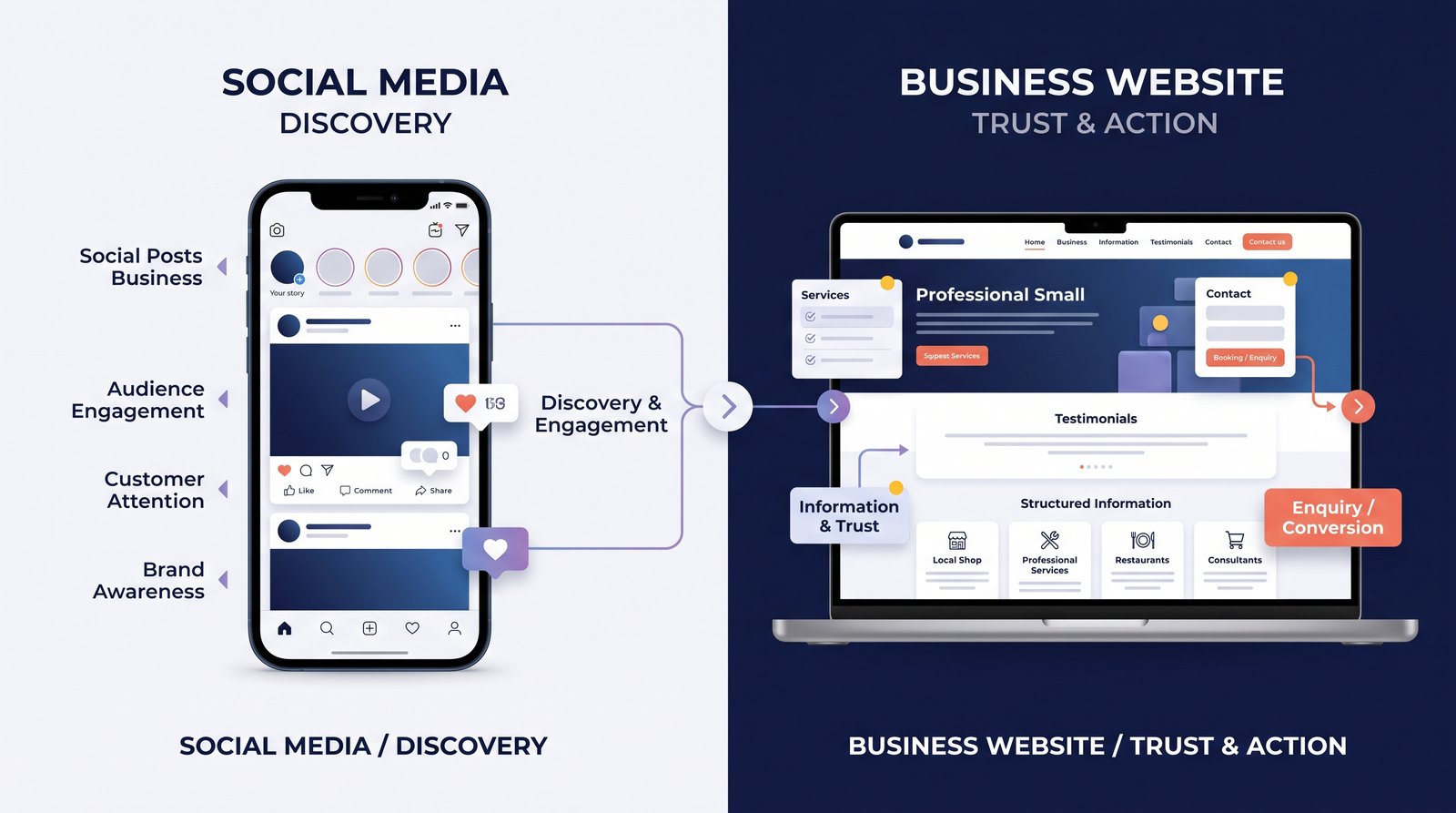
Social media helps people discover and engage with your business.
Your website helps them learn, evaluate, and take action.
The two channels therefore serve different parts of the customer journey.
A person might first discover a company through an Instagram post, visit its website to learn more, and then contact the business through WhatsApp.
That entire journey can work together when the channels are planned properly.
When Should a Small Business Prioritize Social Media?
- Social media may be the better starting point when:
- The business is very new
- Its customers are highly active on social platforms
- Visual content plays an important role in buying decisions
- The business has limited resources
- Building awareness is the immediate priority
For example, a new clothing brand may benefit from building an audience on Instagram or TikTok before investing heavily in a larger digital ecosystem.
However, that does not mean the business should remain dependent on social media forever.
When Should a Small Business Prioritize a Website?
A website becomes especially important when customers need more information before making a decision.
- That can include businesses that offer:
- Professional services
- Healthcare services
- Education and training
- Real estate
- Construction
- Software
- Consulting
- Travel
- E-commerce
- Local services
A website can also be valuable when a business wants to rank in search engines, publish detailed information, collect leads, or provide structured customer support.
Why Relying Only on Social Media Can Be Risky
Social platforms are powerful, but businesses do not control the platform itself.
Algorithms change. Reach can fluctuate. Features can disappear or be redesigned. A social account can also make it harder to organize a large amount of information in a way that is easy for customers to navigate.
A business website gives the company more control over its digital presence.
This does not mean social media is less important. It means the two should ideally complement one another.
Do You Need a Website Before Starting Social Media?
Not always.
A small business can begin building an audience through social media and then introduce a website as its needs grow.
But building a website earlier can make the overall digital strategy more organized.
- For example, social media posts can direct people to:
- A service page
- A booking form
- A product page
- A contact page
- A WhatsApp conversation
- A detailed article or guide
This gives social media somewhere useful to send interested visitors.
What About SEO?
Search engine visibility is another major difference.
A social media post may reach an audience temporarily, but a properly structured website can create pages that continue attracting search traffic over time.
A local business, for example, may want customers searching for a service in its area to find its website.
That can make a website particularly important for businesses that want to build organic search visibility rather than relying entirely on paid or social reach.
What Should a Small Business Invest In First?
There is no universal answer.
- A practical approach is to ask three questions:
Where do our customers discover us?
If most customers discover the business through social platforms, social media should be part of the early strategy.
What information do customers need before contacting us?
If customers need detailed information, a website becomes much more valuable.
What do we want people to do next?
- Businesses should decide whether they want customers to:
- Call
- Send a WhatsApp message
- Book an appointment
- Request a quote
- Buy a product
- Visit a physical location
The digital channel should then make that action easy.
- The Best Approach: Use Both Strategically
For many small businesses, the strongest digital presence combines a website and social media.
- A simple structure might look like this:
- Social Media → Discovery
- Website → Information and Trust
WhatsApp / Contact Form → Conversation
- Sales Team → Conversion
Each channel supports the next step.
The goal is not to collect as many digital channels as possible. It is to create a clear path from discovering the business to becoming a customer.
- Common Mistakes to Avoid
One common mistake is treating social media followers as the same thing as customers.
Another is creating a website without a clear purpose.
A business does not need a huge website to get started. It needs a useful one that answers the questions customers actually have and makes the next step obvious.
Similarly, a business does not need to be active on every social platform. It is usually better to manage the channels where its customers are actually present.
Frequently Asked Questions
It can be enough at an early stage for some businesses, but a website provides more control, structured information, and opportunities for search visibility and lead generation.
Not necessarily. Both can be developed alongside each other. The right order depends on the business and its immediate goals.
Yes. Your social profiles can bring attention, while your website can provide detailed information and help customers take the next step.
There is no single correct budget. The cost depends on the website's size, functionality, design, integrations, and maintenance requirements.
Yes. In fact, connecting the two can create a smoother customer journey. Social posts can direct interested users to specific website pages, forms, products, or contact options.
Final Thoughts
Small businesses do not necessarily have to choose between a website and social media.
Social media is excellent for reaching people, building attention, and staying connected with an audience. A website provides a more structured and controlled place where customers can learn about the business and take action.
For many businesses, the best strategy is to use both—but give each one a clear job.
Start with the channel that best matches your immediate business goal, then build the rest of your digital presence around the customer journey rather than simply collecting platforms.