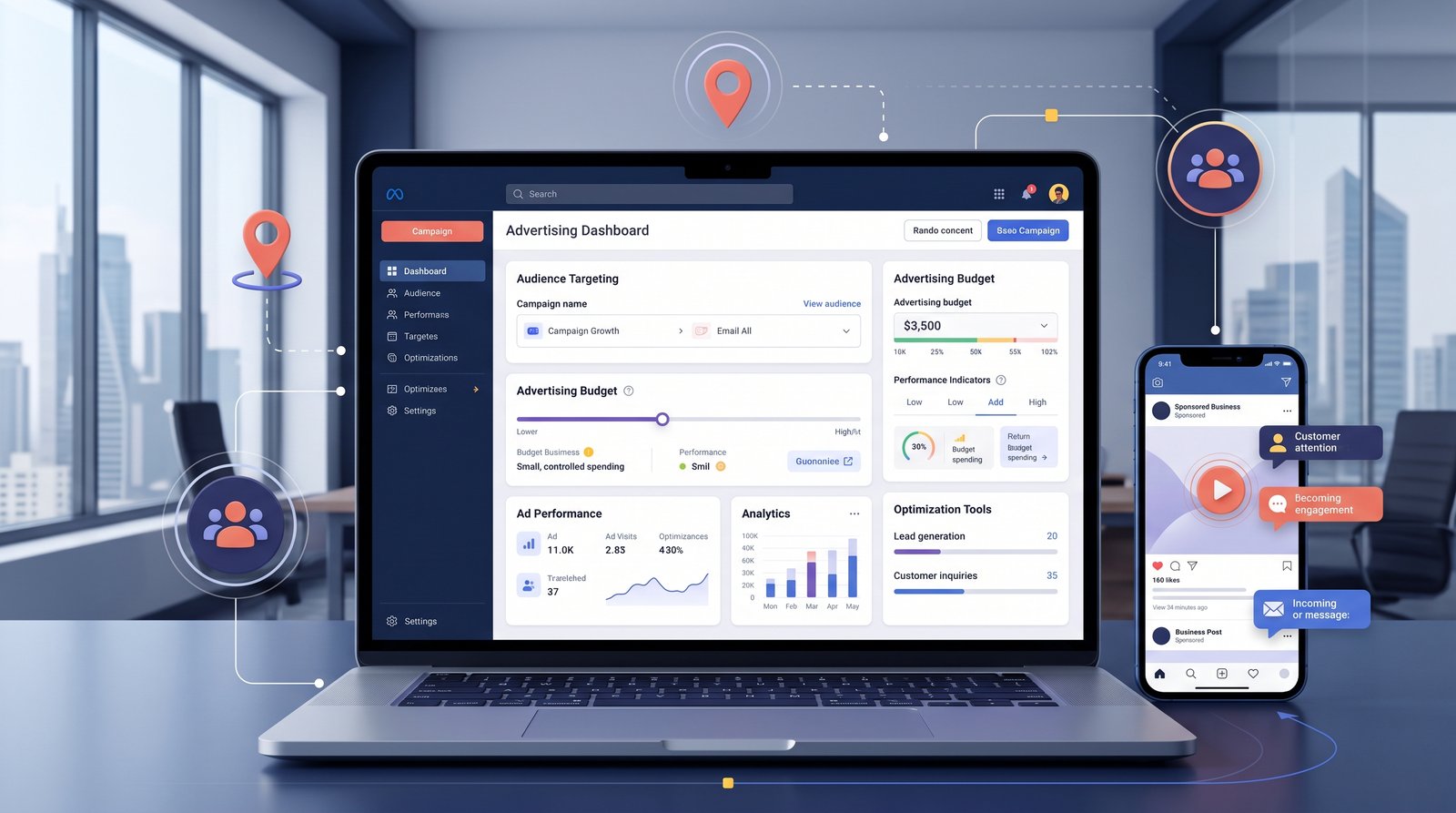
Running Meta Ads does not always require a large advertising budget. For a small business, the bigger challenge is often knowing where to spend the available money, who to target, what to say, and how to measure whether the campaign is actually producing useful results.
Facebook and Instagram can put a business in front of a large audience, but simply boosting a post and waiting for enquiries is rarely a complete advertising strategy.
A smaller budget can still work when the campaign has a clear objective and the money is concentrated on the right audience and creative.
- Start With a Clear Goal
Before creating an ad, decide what you want the campaign to achieve.
- Common objectives include:
- Website visits
WhatsApp conversations
- Lead form submissions
- Product sales
- Appointment requests
- Brand awareness
For example, a local service business may benefit more from generating WhatsApp enquiries than from maximizing post likes.
The campaign objective should match the action you ultimately want the customer to take.
How Much Should a Small Business Spend?
There is no universal “correct” Meta Ads budget.
A business can start with a modest daily budget, gather data, and increase spending when it identifies a campaign that is generating useful results.
The important point is not to spread a small budget across too many campaigns at once.
For example, instead of launching five different campaigns with a small amount of money behind each, a business may learn more by focusing on one clear objective and a small number of well-defined audiences.
- Choose the Right Audience
One of the biggest advantages of Meta advertising is audience targeting.
A local business does not necessarily need to advertise to everyone.
- Consider:
- Location:
Target the cities or service areas where you actually operate.
- Age:
Use a relevant age range rather than making assumptions that are unnecessarily narrow.
- Interests:
Relevant interests can sometimes help, particularly when the product or service has a clear audience.
- Existing customers:
Customer lists or engagement-based audiences can be valuable for remarketing when appropriate.
For a small local business, geographic relevance can often matter more than building an extremely detailed interest profile.
- Keep Your Audience Large Enough to Learn
Over-targeting can become a problem.
If you make the audience extremely narrow by combining too many interests, locations, age restrictions, and other conditions, there may not be enough people for the campaign to learn effectively.
Start with a sensible audience and use actual campaign performance to make adjustments.
The goal is to reach the right people—not necessarily the smallest audience possible.
- Your Creative Matters More Than You Think
Even perfect targeting cannot compensate for an ad that people ignore.
- Your creative should quickly communicate:
What you offer
- Who it is for
Why it matters
What the person should do next
- For example, instead of a generic message such as:
- “We offer digital marketing services.”
- A stronger message might focus on a specific customer problem:
- “Getting website traffic but not enough enquiries?”
The second version gives the audience a reason to pay attention.
- Use Different Creative Formats
Do not assume one format will work for every audience.
- Depending on the business, test:
- Static images
- Short videos
- Reels
- Carousels
- Customer-focused graphics
A restaurant might benefit from food visuals. A professional service company may need a problem-and-solution format. An educational business could use short videos explaining a useful concept.
The creative should fit both the audience and the buying decision.
- Keep the Message Simple
Small businesses often try to put too much information into one advertisement.
- A better structure is:
- Problem → Solution → Benefit → Action
- For example:
- Problem:
- “Still managing customer enquiries manually?”
- Solution:
- “Automate routine conversations with AI.”
- Benefit:
- “Respond faster while your team focuses on important enquiries.”
- Action:
- “Learn More”
This gives the customer a clear reason to continue.
- Use a Strong Call to Action
Your ad should not leave the visitor wondering what to do next.
- Depending on your objective, the CTA could be:
- Send Message
- Learn More
- Get Quote
- Book Now
- Shop Now
- Contact Us
The CTA should match the destination.
If the ad encourages someone to request a quote, sending them to a generic homepage creates unnecessary friction.
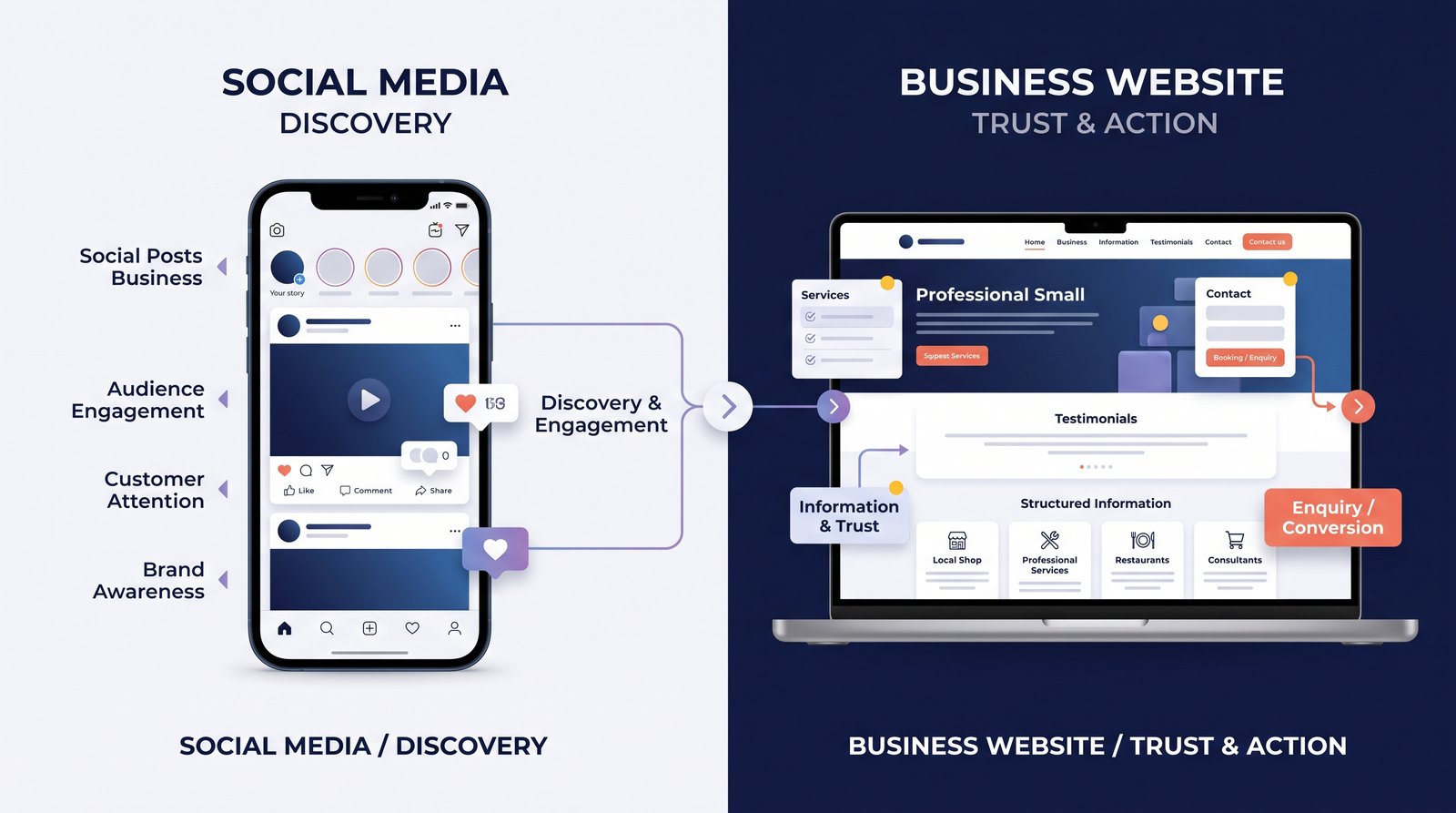
- Send People to the Right Destination
Where the click goes matters.
A campaign promoting a specific service should ideally take users to a page that explains that service rather than forcing them to search through the entire website.
- For example:
- Meta Ad → Service Landing Page → Contact / WhatsApp
- is often a more straightforward journey than:
- Meta Ad → Homepage → Services → Find Service → Contact
Fewer unnecessary steps can make the experience easier for the visitor.
- Track Results Beyond Likes and Reach
Likes, reactions, and impressions can be useful indicators, but they are not necessarily business results.
- Depending on your campaign goal, pay attention to metrics such as:
- Cost per lead
- Number of qualified enquiries
- Cost per conversation
- Conversion rate
- Website actions
- Purchases
- Return on ad spend
A campaign that produces fewer clicks but better-qualified enquiries may be more valuable than one generating large numbers of inexpensive clicks.
- Test One Variable at a Time
When a campaign underperforms, changing everything at once makes it difficult to understand what went wrong.
Instead, test meaningful differences.
- For example:
- Creative A: Problem-focused message
- Creative B: Benefit-focused message
- Or:
- Audience A: Broad local audience
- Audience B: More specific relevant audience
This makes the results easier to interpret.
- Give Campaigns Enough Time to Learn
Small-budget advertisers sometimes turn campaigns on and off too quickly.
A few hours of performance is rarely enough to decide whether an advertisement will work.
Allow enough time to gather meaningful data, while still monitoring the campaign for obvious problems such as poor-quality traffic, irrelevant comments, or unexpectedly high costs.
- Common Mistakes Small Businesses Make
- Boosting Every Post
Boosting a post can increase visibility, but it should not automatically be treated as a full advertising strategy.
- Targeting Everyone
A larger audience is not necessarily better when your business only serves a particular location or customer type.
- Changing Campaigns Constantly
Constant edits can make it harder to understand what is actually driving performance.
- Measuring Only Cheap Clicks
Low-cost clicks are not useful when they produce no meaningful business action.
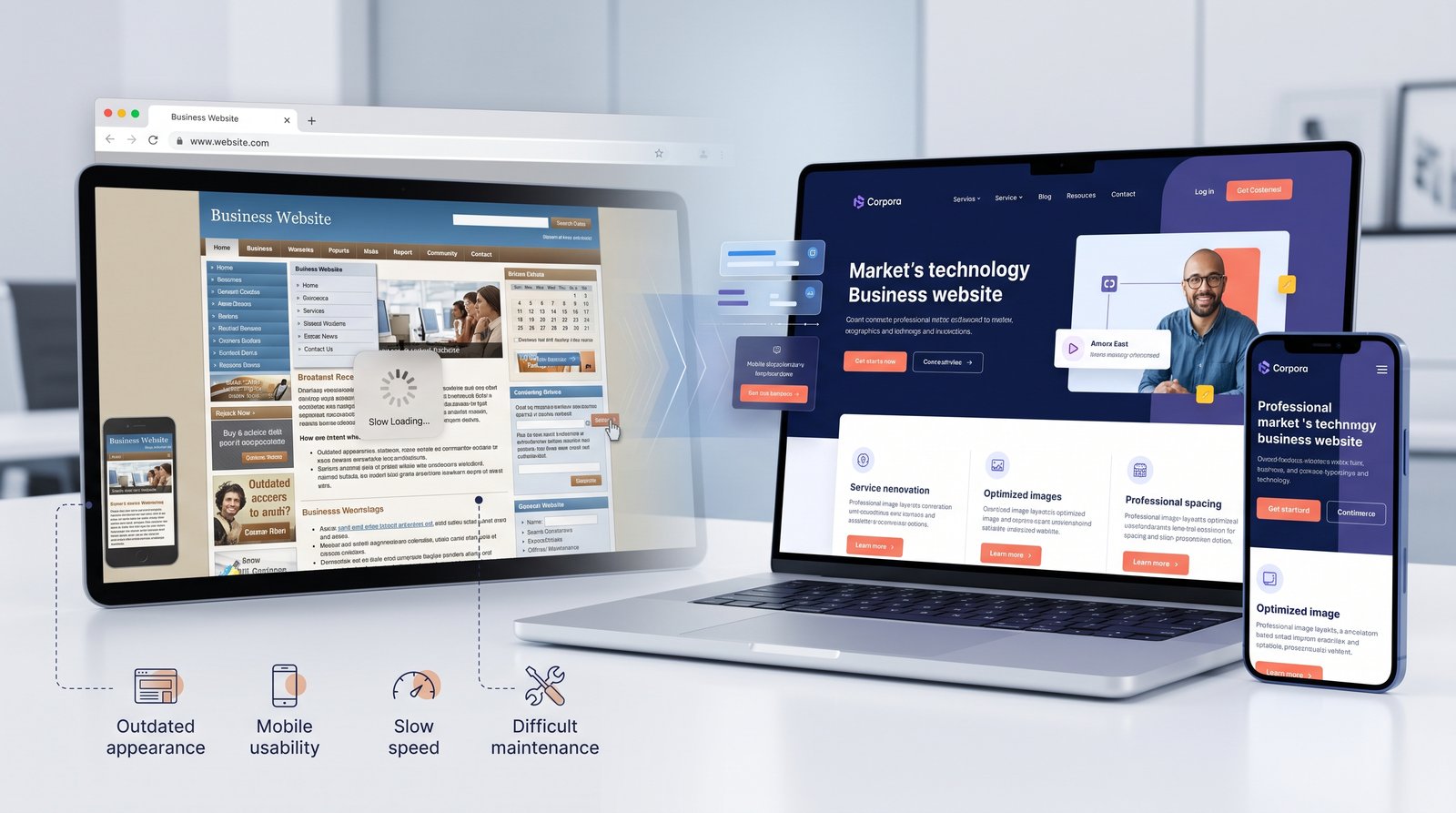
- Ignoring the Landing Page
Even a strong advertisement can underperform if the website page is slow, confusing, or difficult to use.
- A Simple Starting Strategy
For a small Nepalese business, a practical starting setup might look like:
- One clear campaign objective
- ↓
- One or two relevant audiences
- ↓
- Two or three different creatives
- ↓
- A focused landing page or direct WhatsApp destination
- ↓
- Regular performance review
- ↓
- Increase budget only when results justify it
This is more manageable than trying to run multiple complicated campaigns immediately.
Frequently Asked Questions
Yes. A business can start with a modest budget and gradually increase spending based on performance. The most important factor is how efficiently the budget is being used.
Not exactly. Boosting is a simplified way to promote existing content, while Ads Manager provides much more control over objectives, audiences, placements, creatives, and measurement.
There is no fixed number of days that works for every campaign. The appropriate period depends on budget, objective, audience size, and how quickly meaningful data becomes available.
It depends on where the target audience is most active and what type of content the business produces. Using both can be useful when the audience and creative suit both platforms.
Neither works well in isolation. A large budget cannot fix irrelevant targeting, while excellent targeting cannot compensate for an ineffective offer or poor creative.
Final Thoughts
Meta Ads can be a useful growth channel for Nepalese small businesses, even when the advertising budget is limited.
The goal should not be to spend as much as possible. It should be to understand the customer, choose a clear objective, create relevant ads, and measure the business results that actually matter.
Start with a focused campaign, learn from the data, and improve one element at a time. As the business gains confidence and identifies what works, the advertising budget can grow with it.